
Wiki / Folklore
Haji Firooz
In the weeks leading up to Nowruz, performers dressed as Haji Firooz appear in public squares, streets, and bazaars across Iran.
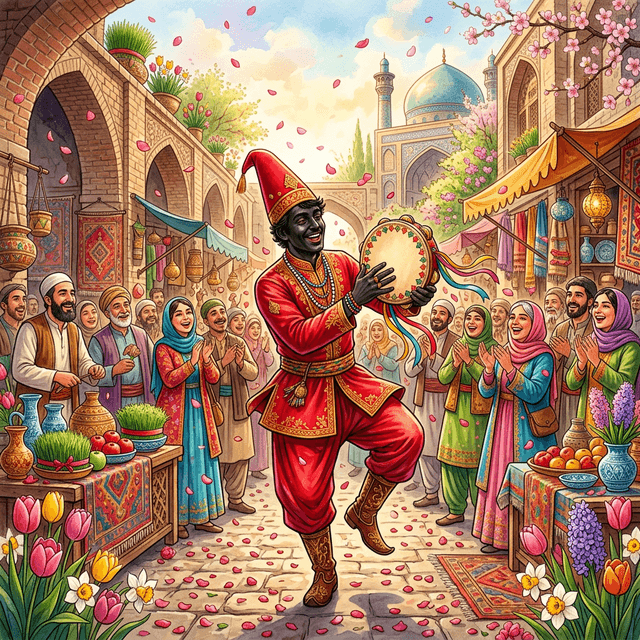
Haji Firooz
Haji Firooz (Persian: حاجی فیروز) is the traditional herald of Nowruz. While Amoo Nowruz represents the peaceful, grandfatherly spirit of spring, Haji Firooz is his lively, energetic companion who fills the streets with music, dancing, and announcements that the new year is coming.
In the weeks leading up to Nowruz, performers dressed as Haji Firooz appear in public squares, streets, and bazaars across Iran.
Appearance and Performance
Haji Firooz is instantly recognizable by his distinct appearance:
- Bright Red Clothing: He wears a vibrant red tunic and trousers, symbolizing fire, warmth, and joy.
- A Felt Hat: A traditional, often cone-shaped or floppy felt hat.
- Soot-Covered Face: His face and hands are traditionally painted completely black with soot.
- Instruments: He plays a tambourine (dayereh) and sometimes small cymbals, singing short, repetitive, and joyful folk songs.
His most famous song is a simple, upbeat chant to get the crowd clapping:
Hāji Firuz-e, sāl-i ye ruz-e! (It's Haji Firooz, it's only one day a year!) Hame midunan, man am midunam! (Everyone knows, I know it too!) Eyd-e Nowruz-e, sāl-i ye ruz-e! (It's the festival of Nowruz, it's only one day a year!)
Historical Origins
The origins of Haji Firooz are complex and debated among historians and anthropologists:
- Zoroastrian Roots: Many scholars believe Haji Firooz represents a Zoroastrian fire-keeper. In ancient times, fire-keepers whose faces were blackened by the soot of the sacred fires would come out into the streets to announce the new year. The red clothing represents the fire itself.
- Mesopotamian Mythology: Other historians link him to ancient Sumerian and Akkadian myths, specifically the deity Tammuz (or Dumuzi), the god of agriculture and flocks, who returns from the underworld every spring. His blackened face represents his return from the realm of the dead, while his red clothes symbolize the blossoming of spring.
Modern Discussions
In recent years, the visual appearance of Haji Firooz has sparked cultural debate. Due to his soot-blackened face, observers outside of Iran have sometimes drawn comparisons to the racist history of minstrelsy and "blackface" in Western cultures.
However, Iranian sociologists and historians generally emphasize that Haji Firooz has no historical connection to Western racial dynamics or the African diaspora. His blackened face is rooted strictly in ancient regional folklore—representing either the soot of a holy fire or the darkness of the underworld from which spring emerges. Despite this, the conversation has led some modern performers inside and outside of Iran to omit the face-painting tradition while keeping the red garments and music.