
Wiki / Folklore
King Jamshid
His story is most famously chronicled in the Shahnameh (The Book of Kings), the national epic of Greater Iran written by the poet Ferdowsi in the 10th century C...
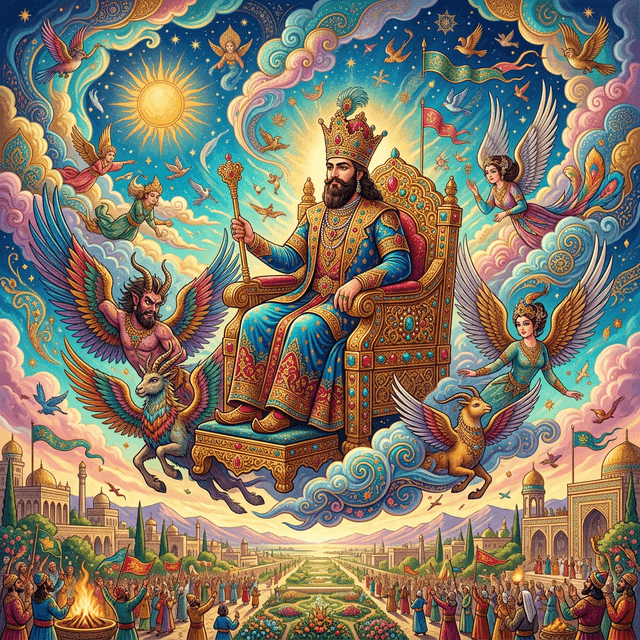
King Jamshid
King Jamshid (Persian: جمشید) is one of the most prominent mythological figures in Iranian folklore and the legendary fourth king of the Pishdadian dynasty. In Persian mythology, he is credited with the founding of Nowruz.
His story is most famously chronicled in the Shahnameh (The Book of Kings), the national epic of Greater Iran written by the poet Ferdowsi in the 10th century CE.
The Legend of the First Nowruz
According to the Shahnameh, Jamshid was a wise and powerful king who ruled over a utopian era where there was no sickness, death, or extreme heat or cold. During his reign, he introduced civilization to humanity, teaching them how to forge iron, weave cloth, build houses from clay, and extract jewels from the earth.
As his power and glory reached its peak, Jamshid ordered the construction of a magnificent, jewel-studded throne. He commanded the divs (demons) he had subjugated to lift this throne high into the heavens.
As Jamshid sat on his airborne throne, the rays of the sun caught the jewels, illuminating the sky with a blinding, divine light. The people of his kingdom, gazing up at this miraculous sight, were overwhelmed with joy and awe. They gathered, scattered jewels, and celebrated the day as a new beginning.
They named this day Nowruz (meaning "New Day" in Persian). This mythological event coincided precisely with the first day of the Iranian month of Farvardin (the vernal equinox).
The Zoroastrian "Vara" of Jamshid (Yima)
The myth of Jamshid evolved from an even older Zoroastrian text, the Avesta, where he is known as Yima. In this ancient version of the story, Ahura Mazda (the supreme creator) warns Yima of an impending, devastating winter that will destroy all life on earth.
To save the world, Yima is instructed to build a giant underground enclosure called a Vara. He brings the seeds of the best plants, the finest animals, and the strongest people into the Vara to survive the eternal winter. When the harsh winter finally passes and the sun returns, Yima and his followers emerge to rebuild the earth.
The celebration of this emergence into the spring sun is considered the earliest mythological origin of Nowruz, symbolizing the ultimate victory of life and warmth over death and cold.