Astronomy & Timekeeping
The Science of the Equinox
Why the Persian New Year starts at a different second every year — the fascinating astrophysics behind Nowruz.
What is the Vernal Equinox?
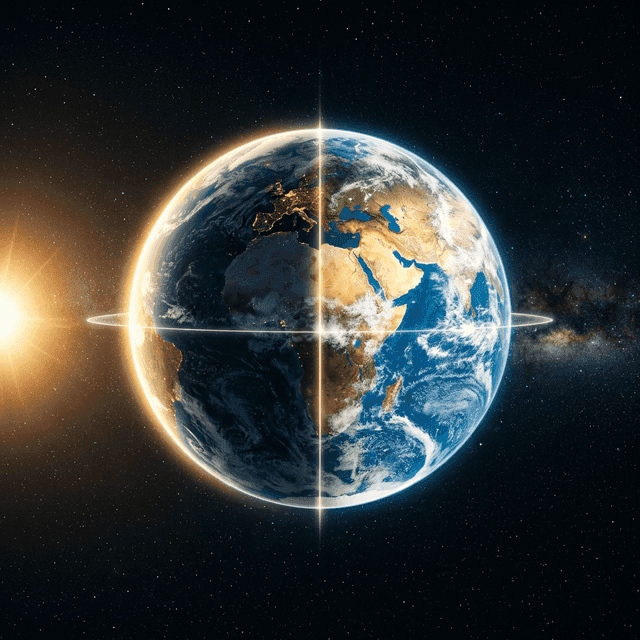
Unlike the Western Gregorian New Year, which begins arbitrarily at midnight on December 31st, Nowruz is built on hard, unyielding astrophysics. It begins at the exact astronomical second of the Vernal Equinox.
Our planet rests on a tilted axis (about 23.5°) as it orbits the sun. For half the year, the Northern Hemisphere is tilted away from the sun (winter), and for the other half, it is tilted toward it (summer).
Twice a year, the Earth reaches a specific point in its orbit where its axis is tilted neither toward nor away from the sun. At this precise geometric moment, the sun's center sits perfectly above the equator. This is the Equinox — from latin aequus (equal) and nox (night).
On this day, everywhere on Earth experiences almost exactly 12 hours of daylight and 12 hours of darkness. It was the moment ancient civilizations knew the harsh cold was over.
The Solar Hijri Calendar
The calendar that uses this celestial event is the Solar Hijri calendar (also known as the Jalali calendar) — the official calendar of Iran and Afghanistan. It is arguably one of the most accurate solar calendars in the world.
While the Gregorian calendar uses leap years every four years with messy exceptions, the Jalali calendar relies entirely on precise astronomical observation. It dictates that the first day of the year (the 1st of Farvardin) is the day the Vernal Equinox occurs.
Before Noon
If the equinox happens before solar noon in Tehran, that current day is Nowruz.
After Noon
If the equinox happens after solar noon, the following day becomes Nowruz.
A Gathering Set by the Stars
Because the arrival of the new year — called Tahvil-e Saal — is based on down-to-the-second planetary geometry, it creates a unique cultural phenomenon.
No matter where an Iranian is in the world — whether in Tehran, Los Angeles, Sydney, or London — they celebrate the turning of the new year at the exact same second. If Nowruz occurs at 4:32:15 PM in Tehran, Iranians in New York are huddled around their Haft-Seen tables at exactly 8:02:15 AM EST.
It is a celebration that requires no clock — only the perfect, undeniable clockwork of the solar system.