Wiki / Culture
Nowruz in Poetry
Persian culture is inextricably linked to its poetry, and Nowruz—as the ultimate symbol of spring, rebirth, and the passing of time—has been a central theme for...
Nowruz in Poetry
Persian culture is inextricably linked to its poetry, and Nowruz—as the ultimate symbol of spring, rebirth, and the passing of time—has been a central theme for the greatest poets of the region for over a millennium.
Poetry is not just read about during Nowruz; it is actively practiced as a ritual at the Haft-Sin table.
Hafez and the Tradition of Faal
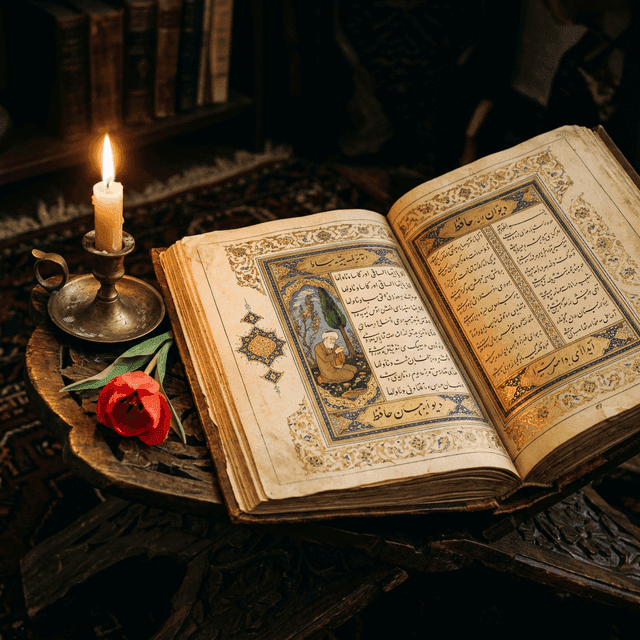
Khwāja Shams-ud-Dīn Muḥammad Ḥāfeẓ-e Shīrāzī (known simply as Hafez) is arguably the most beloved poet in Iran. His book of collected poems, the Divan of Hafez, can be found in almost every Iranian home.
During Tahvil-e Saal (the turning of the year), it is a widespread tradition for families to perform a Faal-e Hafez (fortune-telling or divination through Hafez).
- The eldest member of the family (often a grandfather or grandmother) holds the Divan.
- A family member makes a silent wish or asks a question about the coming year in their heart.
- The elder randomly opens the book to a page and reads the poem aloud.
- The themes of the poem (love, patience, warning, joy) are interpreted as the answer to the question and a guiding light for the person's new year.
Ferdowsi and the Shahnameh
Abul-Qâsem Ferdowsi, the author of the epic Shahnameh (The Book of Kings), is responsible for cementing the mythological origins of Nowruz in written history.
In the Shahnameh, Ferdowsi attributes the creation of Nowruz to the mythical King Jamshid. His majestic verses describing Jamshid’s jeweled throne rising into the sky to capture the sun's rays are still recited today to honor the ancient, pre-Islamic roots of the festival.
Omar Khayyam and the Calendar
Omar Khayyam was not only a brilliant poet but also a master astronomer and mathematician. In the 11th century, he was part of the panel of scholars commissioned to reform the Iranian calendar, resulting in the Jalali calendar (the predecessor to the modern Solar Hijri calendar), which accurately anchored the new year precisely to the vernal equinox.
In his famous Rubaiyat, Khayyam frequently uses the imagery of spring and Nowruz to reflect on the fleeting nature of life, urging the reader to enjoy the present moment, drink wine, and appreciate the blossoming nature before time runs out.
Rumi and the Spiritual Spring
Jalāl al-Dīn Muḥammad Rūmī often used the arrival of spring and Nowruz as a metaphor for spiritual awakening. In his Sufi philosophy, just as the dead earth is miraculously brought back to life by the spring breeze, the human soul can be revived by divine love. For Rumi, Nowruz is an internal, spiritual revolution as much as it is a seasonal change.